
 Image 1 of 1
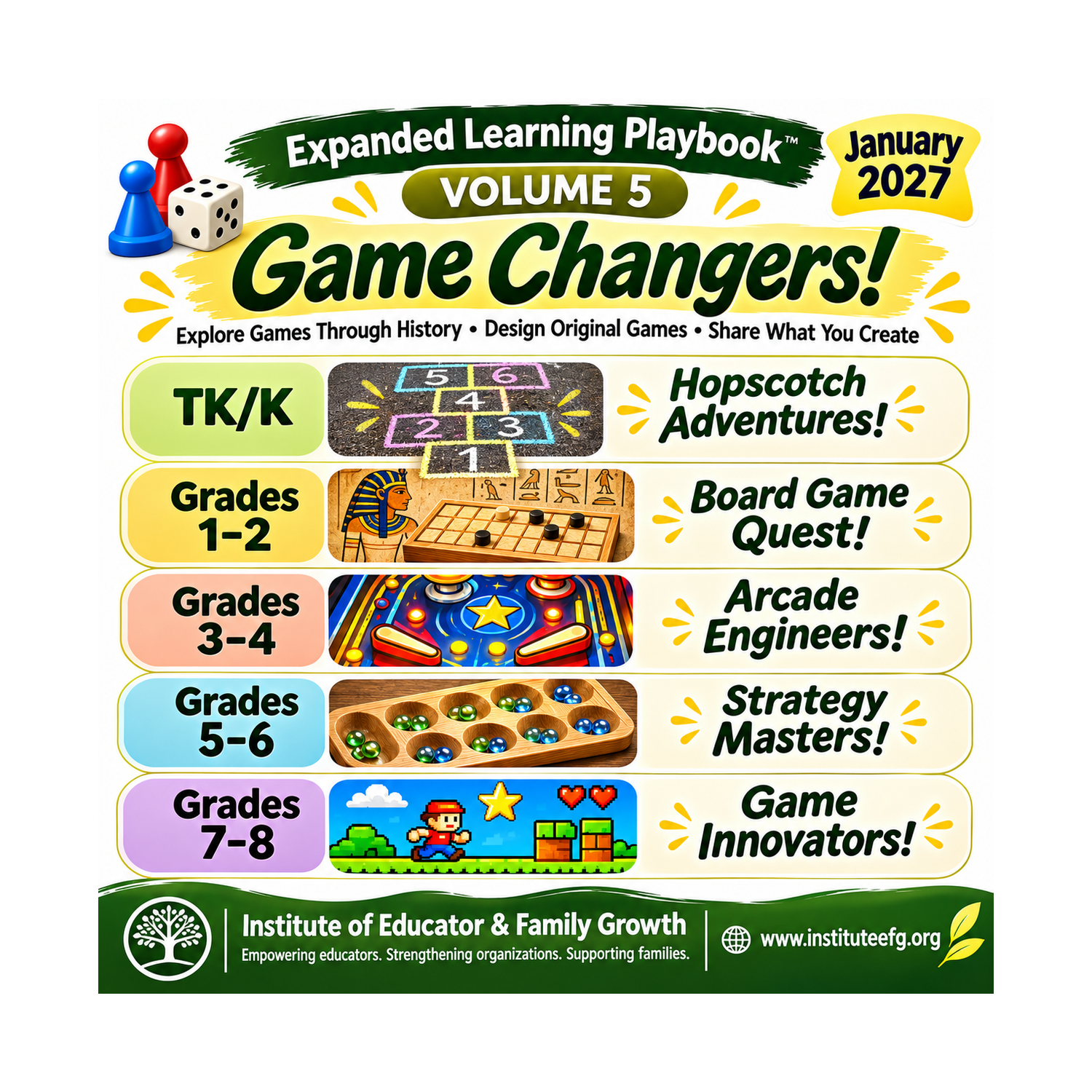
Expanded Learning Playbook™ – Volume 5 (January 2027)
The Expanded Learning Playbook™ – Volume 5 (January 2027) invites students to explore the exciting world of games through Game Changers!, an engaging four-week experience designed specifically for expanded learning programs serving Transitional Kindergarten through 8th grade. Through hands-on, project-based learning, students discover famous games throughout history, explore how games have evolved across cultures and generations, and design, build, test, and share original games while developing critical thinking, creativity, collaboration, communication, and problem-solving skills.
Volume 5 provides expanded learning professionals with ready-to-use programming that complements the school day while fostering curiosity, innovation, strategic thinking, confidence, and meaningful student engagement. Each grade level follows a carefully designed progression of developmentally appropriate activities that integrate history, culture, mathematics, science, engineering, literacy, physical development, executive functioning, technology, and leadership. Older students strengthen research, analytical thinking, communication, and organizational skills through game investigations, strategic challenges, engineering projects, digital game development, playtesting, and student-led presentations.
Unlike traditional January programming, Game Changers! moves beyond winter-themed activities and New Year's resolutions to provide meaningful learning experiences grounded in game history, cultural exploration, engineering, strategy, innovation, and authentic project-based learning. Students discover how games have entertained, challenged, and connected people throughout history while investigating how creativity, technology, and new ideas have transformed the way people play. The unit concludes with an exciting community experience, The Ultimate Game Festival, where students showcase their original games, demonstrate their inventions, and invite families, classmates, and community members to participate in interactive game experiences.
What's Included
✓ Four-Week Project-Based Learning Journey
Guide students through a comprehensive Game Changers! unit featuring four weeks of developmentally appropriate, hands-on learning experiences. Each week includes activity guidance, materials needed, opportunities for exploration and student choice, and a progressive game-design project.
Students move through a creative process of exploring, planning, designing, building, testing, improving, and sharing their games. Activities encourage students to experiment with materials, develop original ideas, solve problems, collaborate with peers, and create games that others can enjoy.
✓ Games Through History: Historical Game Spotlights
Introduce students to famous games and the fascinating history of gaming, including Hopscotch, Senet, Bagatelle and Pinball, Mancala, and Pong.
Each grade level explores a different historical game or game tradition, investigating its origins, cultural significance, rules, development, and influence on modern gaming.
TK/K — Hopscotch: Discover how movement games have connected children across generations and cultures.
Grades 1–2 — Senet: Explore one of the earliest known board games, played in ancient Egypt thousands of years ago.
Grades 3–4 — Bagatelle and Pinball: Investigate how early tabletop games evolved into mechanical arcade experiences.
Grades 5–6 — Mancala: Explore traditional counting and strategy games played in different forms across Africa and other regions of the world.
Grades 7–8 — Pong and Digital Gaming: Examine how early electronic games helped transform entertainment and inspired modern digital game development.
Students connect historical discoveries to their own game designs while developing an appreciation for the creativity, cultural traditions, and innovations that have shaped gaming throughout history.
✓ Grade-Level Learning Progressions
Developmentally appropriate programming for TK/K, Grades 1–2, Grades 3–4, Grades 5–6, and Grades 7–8, with increasing complexity, independence, strategic thinking, engineering, creative problem-solving, leadership opportunities, and technology integration throughout the four-week experience.
Each grade level features a distinct game-inspired theme and hands-on learning activities:
TK/K — Hopscotch Adventures! Explore movement games, counting, coordination, and cooperative play while inventing a giant movement game.
Grades 1–2 — Board Game Quest! Investigate ancient board games and create original games with pathways, playing pieces, rules, and challenges.
Grades 3–4 — Arcade Engineers! Explore ramps, targets, force, motion, and mechanical design while building an original arcade-style game.
Grades 5–6 — Strategy Masters! Investigate strategy games, logical reasoning, and decision-making while designing and testing an original strategy game.
Grades 7–8 — Game Innovators! Explore the evolution of gaming and develop original tabletop, digital, or hybrid games, including prototypes and promotional presentations.
✓ Hands-On Game Design & Project-Based Learning
Each grade level completes a unique culminating game-design project, including a Giant Movement Game, Original Board Game, Arcade-Style Game, Strategy Game, or Interactive Game Experience.
Students apply their learning by developing game concepts, selecting materials, establishing rules, creating prototypes, testing gameplay, gathering feedback, and making improvements.
The experience emphasizes authentic student choice and creativity, allowing students to develop their own game concepts within developmentally appropriate project categories.
Activities incorporate readily available classroom and household materials whenever possible, making implementation practical and affordable for expanded learning programs.
✓ The Ultimate Game Festival
Bring the entire expanded learning community together for an exciting, student-centered celebration of creativity, innovation, and learning.
The Ultimate Game Festival transforms the program into an interactive gaming experience featuring five distinct grade-level game zones:
TK/K — Move & Play Zone: Student-created movement games and interactive physical challenges.
Grades 1–2 — Board Game Café: Original board games designed and facilitated by students.
Grades 3–4 — Inventors' Arcade: Student-engineered arcade games featuring ramps, targets, scoring systems, and mechanical challenges.
Grades 5–6 — Strategy Challenge Lounge: Original strategy games that encourage planning, logical reasoning, and decision-making.
Grades 7–8 — Digital Game Showcase: Interactive game prototypes, digital experiences, promotional trailers, and student game pitches.
Students serve as game designers, facilitators, presenters, and event hosts while inviting others to explore and play their creations.
The culminating event can be held during the school day to strengthen collaboration between expanded learning and school-day programs, or organized as a family and community engagement experience.
✓ Technology Connections
Older students progressively strengthen digital literacy, creative technology, and media production skills through online game-history investigations, digital game planning, game development platforms, promotional materials, multimedia presentations, and video production.
Students explore tools such as Scratch, Canva, and other age-appropriate digital platforms to design games, develop interactive experiences, create promotional trailers, and present their work.
Technology integration emphasizes creativity, responsible digital citizenship, problem-solving, communication, and the relationship between technology and innovation.
✓ Game History & Cultural Connections
Introduce students to gaming traditions from different historical periods and cultures, including ancient Egyptian board games, traditional strategy games, early mechanical games, and modern digital gaming.
Students explore how games reflect the values, interests, technologies, and traditions of the societies in which they developed.
Through historical investigations, students examine how games have changed over time, why certain games remain popular across generations, and how innovations in materials, technology, and design have created new ways to play.
✓ STEM, Engineering & Mathematical Thinking
Integrate science, technology, engineering, and mathematics through authentic game-design challenges.
Students investigate counting, patterns, measurement, geometry, probability, scoring, logical reasoning, and mathematical strategies while creating original games.
Engineering experiences introduce concepts such as force, motion, ramps, targets, mechanical systems, prototyping, and iterative design.
Students learn to approach challenges as designers and problem-solvers by testing ideas, identifying problems, analyzing results, and making improvements.
✓ Family, School & Community Connections
Strengthen connections between expanded learning programs, school-day educators, families, and the surrounding community through collaborative game-design experiences and interactive celebrations.
The Ultimate Game Festival provides opportunities for families, classmates, teachers, and community members to experience student-created games, participate in challenges, and celebrate student learning.
Programs can also organize the event during the school day to demonstrate how expanded learning complements classroom instruction through meaningful applications of history, mathematics, science, engineering, literacy, and technology.
✓ Executive Functioning & 21st Century Skills
Intentionally develop planning, organization, flexible thinking, collaboration, communication, creativity, critical thinking, leadership, problem-solving, perseverance, and responsible decision-making through authentic game-design experiences.
Students learn to establish goals, develop rules, organize materials, evaluate alternatives, anticipate outcomes, manage challenges, respond to feedback, and revise their work.
Collaborative projects provide meaningful opportunities to practice teamwork, negotiation, leadership, communication, and conflict resolution while developing games that are enjoyable and accessible to others.
✓ Download, Print & Go
Designed in a professional 11 × 14 magazine-style format that is easy to download, print double-sided, and fold into a polished programming resource for your expanded learning program.
Each grade-level section features a colorful, game-inspired two-page spread with historical learning, three hands-on activities, developmental connections, a signature project, a four-week activity guide, weekly materials lists, and guidance for preparing the culminating game experience.
The Playbook also includes a grade-level programming overview and The Ultimate Game Festival planning guide, helping expanded learning professionals coordinate meaningful learning experiences and an engaging culminating event.
Skills You'll Strengthen
✓ Project-Based Learning (PBL)
✓ Game Design & Innovation
✓ Game History & Cultural Awareness
✓ Creativity & Imagination
✓ Critical Thinking & Problem-Solving
✓ STEM & Engineering Design
✓ Mathematics, Logic & Strategic Thinking
✓ Science, Force & Motion
✓ Research & Inquiry Skills
✓ Collaboration & Communication
✓ Literacy & Instructional Writing
✓ Physical Development & Coordination
✓ Executive Functioning Skills
✓ Technology Integration & Digital Literacy
✓ Computational Thinking & Game Development
✓ Prototyping, Testing & Revision
✓ Planning, Organization & Decision-Making
✓ Leadership & Entrepreneurship
✓ Public Speaking & Presentation Skills
✓ Event Planning & Organization
✓ Family, School & Community Engagement
✓ Confidence, Perseverance & Lifelong Learning